Friday, September 21, 2012

Another Day Another Festival (and Enkai)


            Howdy everyone, time for another update in the land of the rising sun. I continue to learn more and more about the Japanese education everyday but last weekend offered some really interesting and new insights when I was invited to one of my schools’ taiikumatsuri or sports festivals. At first, I thought that the schools’ sports festival would be something roughly comparable to a track and field day such as I encountered back in my time in elementary school. However, the Japanese sports festival was actually something quite different. The festival consisted of the students playing a variety games, virtually all of which were focused on teamwork and group efforts. Thus, instead of events that celebrate individual athletic achievement such as the 200m dash, pole-vaulting, or shot put, games such as tug o’ war and three legged races were the norm. Adding to the theme of group effort and teamwork, the sports festival, somewhat strangely, consisted of synchronized dance routines to Japanese pop music (often called J-pop), which leads me to believe the translation “sports festival” is a slight misnomer. Nevertheless, the festival  was quite a lot of fun to watch and quite enlightening on how group values are hammered in at Japanese schools.  

           Still, there were a few events in which students competed as individuals such as an obstacle course of which I was apart of. During my portion of the obstacle course, the students had to beat me in a game of janken (Japanese version of rock paper scissors) in order to pass to the next obstacle. On an interesting side note,  janken carries a lot of weight in Japanese schools from what I’ve seen. Indeed, many a dispute is resolved and many a decision made via janken, which means that almost all of the students have the remarkable ability to play the game at lightning fast speeds that I ne’er thought impossible. Suffice to say, a significant amount of students were able to obliterate me during the obstacle course. Unfortunately, I have been told that I am not allowed to take pictures of my students and post them on blogs, Facebook, etc. so I can’t provide any pictures of the sports festival.

            After the sports festival was finished, I was invited to yet another enkai (office party). This enkai, however, differed in that we started off by going to an onsen (a public bath or hot spring). As those who enter an onsen are forbidden to wear clothes, the group separated between the males and females. After getting used to the fact that I was surrounded by a bunch of nude middle-aged men, I daresay entering the onsen was one of the more relaxing things I’ve ever done. After the onsen, the whole party came back together for dinner, which was a delectable selection of various sashimi (raw fish slices), miso soup, grilled shrimp, rice, and as always, plenty of beer and sake.

Delicious!

         Although I thoroughly enjoy enkais (good places to bond and have fun with my fellow teachers) I must confess that I hope there won’t be any more for a while. Enkais are absurdly expensive! This last enkai set me back a good 7700 yen or about 98 dollars!

        The day after the enkai, I went to a festival called the Lion Dance that was being held in the city of Tsubata, about an hour and half south of my home in Noto-chou. As I mentioned in one of my previous posts, Japanese festivals are really intense, and this festival proved to live up to that promise and even raised the bar a little bit. In this festival, pairs of dancers took turns dancing in the middle of an intersection with various weapons such as spears and katanas. 

The Spear Dance

        Surrounding these dancers at each corner of the intersection were groups of Japanese men (all very drunk of course) carrying a large dragon float. Each of these various dragon float groups would then take turns crossing different corners to beat the ever-loving crap out of the other groups. Indeed, the level of violence was so intense that at one point, I literally saw one guy jump up and side kick another guy right in the stomach. Fascinatingly, however, as soon as the dragon float retreated, all of the fighters would more or less stop and start hugging each other. 


          Thinking about if this type of festival were to happen in the States, I can only imagine a full-scale riot ensuing.  At the end of the festival, however, the participants were not in the process of rioting as many of them had ended up like this gentleman here:

Vanquished by the Festival
             As the day after the festival shenanigans was a public holiday (Respect for the Aged Day) several JETs and I went to an island on the Noto peninsula and did some swimming. Once more, the water was ridiculously warm, the surrounding area stunning, and the atmosphere serene. The swim was made especially magical by an abundance of fish that would leap very high out of the water to catch mayflies.
JETs on the Beach
            In terms of work, things are starting to look up in one of my junior highs at least. It seems I can get a lot student’s attention by shouting vocabulary words at the top of my lungs and by using an array of goofy voices and impressions of celebrities. This always seems to do the trick in terms of catching their attention and after that, they seem much more apt to participate when I need them to.
            
            On a sadder note, come October, a new Japanese law will come into effect that is basically the SOPA law that was defeated in the States several months ago. Since the wording of the law is very vague, it is entirely feasible that I could get arrested and fined for watching videos on Youtube. As I already don’t have access to Spotify, Netflix, and Hulu over here, this news certainly comes as huge blow to my spare time. Time to watch ALL the Youtube while I can!

            Anyway that’s all for now. Not too much happening this weekend except maybe a trip to Kanazawa this Saturday for dinner. Talk to y’all later and I hope to see some of you on skype soon!


Tuesday, September 11, 2012

Lessons from a Japanese Classroom


Hello everyone it's been a while! My life has really shifted from 0 to 60 in the last week so I have had precious little time and energy to update the ol' blog. Without further ado, here is what I have been up to since my last post.

Starting last week, my job teaching English truly began as all of the students returned to school from summer vacation. As mentioned before, I am currently teaching at  3 elementary schools and 3 junior highs. As the area I live in is rural and sparsely populated, the class sizes are consequently little with some grades being as small as 8 kids. As an assistant language teacher (ALT) my job entitles coordinating English classes with local Japanese English teachers. 

The reality of the situation, however, is that every school I visit operates very differently both in terms of what the school expects of me and in the behavior of the students. At some schools, it seems that the teachers don`t really know what to do with me and I am mostly regulated to being a human tape recorder regurgitating vocabulary words. At other schools, however, I have lot more opportunity to add my own input into the lesson and work a lot more closely with the teachers. In particular, this tends to happen more at the elementary school level where the teachers' English abilities are often not as good. Interestingly, one elementary school even has me helping out with Japanese lessons! There are two western kids (Canadians I think) whose parents are local missionaries so sometimes I help their Japanese tutor translate basic Japanese phrases and vocab into English and vice-versa. 

In terms of student behavior, again, there seems to be a great amount of variance between each school. On the whole, there is a noticeable disconnect between elementary and junior high students. The best way to describe my elementary school students would be enthusiastic and chaotic. Almost all of them seem very very very excited to have me in the class and went absolutely crazy when I did my self-introduction lesson. In particular, they loved seeing pictures of Minnesota animals and I almost started a riot in some classes when I said that I liked Totoro (a famous Japanese cartoon). Indeed, teaching at elementary school even caused me to become injured as I sprained my toe while jumping around for one of the classes (they wanted to see how high I could jump since I am a giant here). I daresay I did not expect to get injured while teaching here haha. Regardless, teaching at elementary schools is definitely a lot of fun and something I really enjoy doing. 
Junior High, on the other hand, is a completely different ball game. Although almost all of the students smile, wave, and seem very excited to see me outside of class. However, the moment the bell rings, it is like an invisible soul-sucking vampire has leeched all of that enthusiasm out of them. Most of the junior high students I teach are INCREDIBLY quiet in class and just getting one of them to even say "hello my name is blank", is like pulling teeth. More often than not, I will get either a blank stare or the student in question will have their eyes towards the floor and mutter so quietly I can't even hear them. I hope that this will pass in time as I get to know them more, but it is still a very strange phenomenon to me nevertheless. 

Here are some miscellaneous things I`ve noticed about the Japanese education, some good, some bad and some things that are just different.

Good: The school lunches! Japanese school lunches kick the crap out of American ones as the food is not only edible, but quite tasty as well. Plus I get to eat with the kids, which creates a more relaxed atmosphere. (The teachers eat with them as well).


Bad: The lack of participation and disinterested atmosphere of most junior high classes.

Good: The friendliness of junior high students outside the classroom.

Different: It is acceptable and quite common to see members of the same sex holding hands (in a platonic way).

Good: The elementary school kids are adorable and a lot of fun to teach.

Bad: Things can get out of hand quick with them if the teacher or I don`t calm them down.

Good: Japanese students are given more responsibility for their school. This means that they are in charge of cleaning. This creates a good atmosphere of collective responsibility that make for very clean schools free of vandalism.  

Different: Japanese kids are given homework over summer vacation I guess it’s good that they aren't like American kids who forget everything over break, but I can`t imagine they`re too thrilled about it haha.

Bad: Lesson plans seem a little disorganized for English classes at the elementary school level so I often don`t know what I'll be teaching until I get there. I guess it`s not too bad though as long as I have a generic game that can be applied to many lessons (ex. Simon says)

Keeping my eye out for: Bullying. Apparently it can be a huge problem in Japanese schools and as almost all of it is done by electronic devices (phones and facebook) and it is increasingly difficult for teachers to catch it.

Funny: Some of the questions I get from Japanese students some of which are over the top personal. Top ones thus far are: What is your blood type? Do you have a girlfriend? How much do you weigh? How much money do you make? Will you marry the the teacher you are working with? I mostly just laugh it off or make up a lie like I have 10 girlfriends (that usually gets them giggling).

After a very exhausting week, one of my schools invited me to an enkai, or office party, last Friday. This presented a wonderful chance to immerse myself in Japanese customs and to get to know my co-workers better so, of course, I accepted. The enkai took place at a nearby izakaya (kind of like a bar that serves a variety of drinks and grilled food) and was a very fascinating experience. The first thing that I noticed about the enkai was that although it presented a rare opportunity for the teachers to be at ease, it nevertheless had certain rituals that had to be followed before the revelry began. Each person had a designated seating arrangement based on seniority, and it was absolutely important, I was told, to not start drinking or eating until the principal gave the official kanpai! (cheers). After this ritual was finished, however, the environment underwent a drastic change. Gone where all the rigidity and social hierarchy and in came a much more egalitarian and relaxed atmosphere. Indeed, by the end of the night I was surrounded by some very inebriated colleagues, which is totally acceptable and, indeed, almost expected here.

The food served at the enkai was also a very fascinating experience. For every four of us sitting at a table, we were provided with raw ingredients, a small grill, and a cup of sesame sauce in which to dip these ingredients once they had been cooked. The ingredients consisted of basic raw veggies such as cabbages, onions, and peppers. The meat was more exotic consisting of various cow parts such as tongue, stomach, and intestines. Although many of my American readers probable revile the thought of eating such bizarre foods, I must say that they really were quite delicious (For those of you who watch Andrew Zimmer, know that he also praises the flavors of intestine and tongue). Unfortunately, I forgot my camera so I didn't document the affair. Oh well. 

I also experienced my first pang of homesickness last week. I guess it came when I saw all the facebook statuses about going back to Gustavus from all of my friends. It hurts even more knowing it will be at least another two years before I can attend my fraternity's (Sigma Alpha Epsilon) initiation ceremony as an alumni. Still, I am enjoying life here a lot and find that even the little things can go a long way to combat homesickness. For example, I recently discovered that the bakery by my house has really good deals on delicious baguettes (the guy who runs the place is an Aussie so he knows his stuff) so I can now get my bread fix, which helps a lot.

Flatt's Bakery

 I also recently bought a bicycle and there are some really spectacular mountain and seaside trails I can ride around here, which I find very therapeutic. 

The trail I take
Also, as some of you have requested, here is a picture of my car. It is a Toyota and it is called a "Starlet" (yeah I know they give cars realllly weird names over here). Thus, I have christened it with the name Starlet Johansson.  

Starlet Johansson

Monday, August 27, 2012

輪島大祭 (Wajima Taisai)

Howdy doody everyone! Time for another update.

As stated in my last post, last wednesday, I was asked to read Edgard Allen Poe`s The Raven to a Japanese audience. The reading itself was quite a bizzare and surreal experience. Having never acted or done dramatic readings before, it took all of my inner strength to not burst out laughing and knowing I was speaking to an audience who had absolutely no idea what I was saying. Further compounding the hilarity of the situation was listening to the Japanese translation of The Raven that my supervisor was reading. One can only hear Nebamoru the Japanese phonetic translation of nevermore so many times before they start to crack up. Even worse, the only instance where I`ve actually heard The Raven read outloud was from The Simpsons` Halloween episode adaption. As this version was read by the sublime voice of James Earl Jones, that is precisely the voice that was running through my head the whole time. Suffice to say, I must have looked very strange trying to contort my face into serious mode the whole time. Oh, and I forgot to mention the whole thing was going to the local newspaper. Here is the article that was published:

Famous
After this rather strange episode, I got my very first taste of a Japanese matsuri (festival) last weekend. Before I go into detail about my experience, I will give a little background on Japanese  religion that I feel is important to undertand. One important aspect of religion in Japan that is important to be cognizant of is Shinto (roughly translates to the way of the gods). Shintoism and religion is a rather complicated subject and I am oversimplifying, of course, but Shinto can be thought of as Japan`s native religion. Shinto generally holds that the world is inhabited by kami (gods or spirits) and that they are present in all forms of nature in the world, from living things such as animals and trees, to inanimate objects such as rocks. Another important aspect of religion in Japan is Buddhism, which was exported to Japan via China and Korea in roughly the 6th century. One way that the Japanese concept of religion has differed greatly from many wetsern attitudes is that religious views are not neccissarily mutually exclusive. Thus, one can similtaneously be both Buddhist and Shinto at the same time. Indeed, over the years, these religions have meshed together so much that it is often very difficult to tell which traditions and temples are exclusively Buddhist and which are Shinto.

Japanese festivals are traditionally a product of this mixed Buddhist/Shinto worldview and many concern kami or incarnations of the Buddha in some fashion. Some of these are done to thank the gods for favorable historical events (such as Wajima Taisai, part of it commemorates the warding off of enemy Samurai in the 16th century), others are meant to praise a certain kami, or to ward off evil spirits. In conclusion, they are very diverse in meaning. Interestingly enough though, it would seem that the meaning is lost on many participating in the festivals and is widely used as an event to get and drunk and go CRAZY! I caps locked the word "crazy" because Wajima Taisai is very much one of the most wild celebrations in which I've ever participated. Whole streets were filled wall to wall with very inebriated (and still holding their beers and sake in hand) and very wild Japanese people.

Waiting by the kirko (portable shrines).

Anyway, Wajima Taisai goes on for four nights! Each night, different squads of very drunk Japanese carry their respective kiriko (portable shrines) throughout the streets of Wajima spinning them wildly and banging on Taiko drums the whole time. The bellow clips are of a kiriko being carried and spinned, and a guy dressed as Spiderman banging on Taiko drums (like I said, very wild party).

Who knew Spiderman was a very good drunk taiko player?

After the various squads of kiriko arrive at their destination, the festival gets even wilder. A giant pole is set up in the middle of the town where the various teams gather. The pole is then promptly set on fire because drunk people and fire is a always a good combination. It gets even better though, in the pole is a special stick that if a team grabs and returns to their base, they are granted good fortune. At this point in the festival, I felt as though I were in the middle of a mosh pit as various teams literally brawled with each other around the blazing pole to get that stick. I would post a video of it, but evidently I have reach the max amount of memory allotted in this post. Maybe I'll put it up on a different one.

In terms of getting used to life in Japan, as always, the language barrier proves to be the greatest challenge. For those of you who are familiar with the film Good Burger, I often find myself repeating Ed (see link).


Monday, August 20, 2012

きれい金沢 (Beautiful Kanazawa)


            Hello everyone! I return to you now with another update. Again, a lot has happened since my last post so I will try to summarize as best as I can. Life in Japan continues to be fantastic and I am still filled with euphoria about living here despite the language barrier and various cultural disparities that inevitably happen everyday. I have started going to the assorted junior highs and elementary schools I will be teaching at and am doing my best to learn the names of my co-workers but, alas, I have quite a few of them and it is proving to be an arduous task (time to make a seating chart it seems). As classes won’t commence until early September, most of my time at the office has thus far been spent studying Japanese and preparing my English self-introduction that I will give to all my schools (fun fact many of you who are reading this post will be featured).

            In terms of non-work related events, my last two weekends have been filled with all sorts of interesting experiences. Two Saturdays ago, I was invited to a puppet show performed by the students of Kanazawa University for the local children in one of my nearby villages. The show was a good opportunity to meet some of the local kids, and I was rather glad the show was for children because I could actually understand most of the simple Japanese vocab and grammar being employed (I was able understand stuff made for 1st graders Woot! Woot!) From what I gathered, the puppet show was about a group of children who encounter a Kappa (a Japanese mythical creature that is like a turtle-monkey combination) and the shenanigans that follow.

Kappa Play

        The next day, my Japanese Board of Education supervisor, Muroishi-san, generously invited my co-worker, Jillian, and myself over to his house for dinner. I had a splendid time meeting his family and eating myself silly with all of the delicious food his wife made. We concluded the evening by setting off some fireworks and listening to Muroishi-san talk about Japanese constellations (of which he apparently knows everything according to his wife).

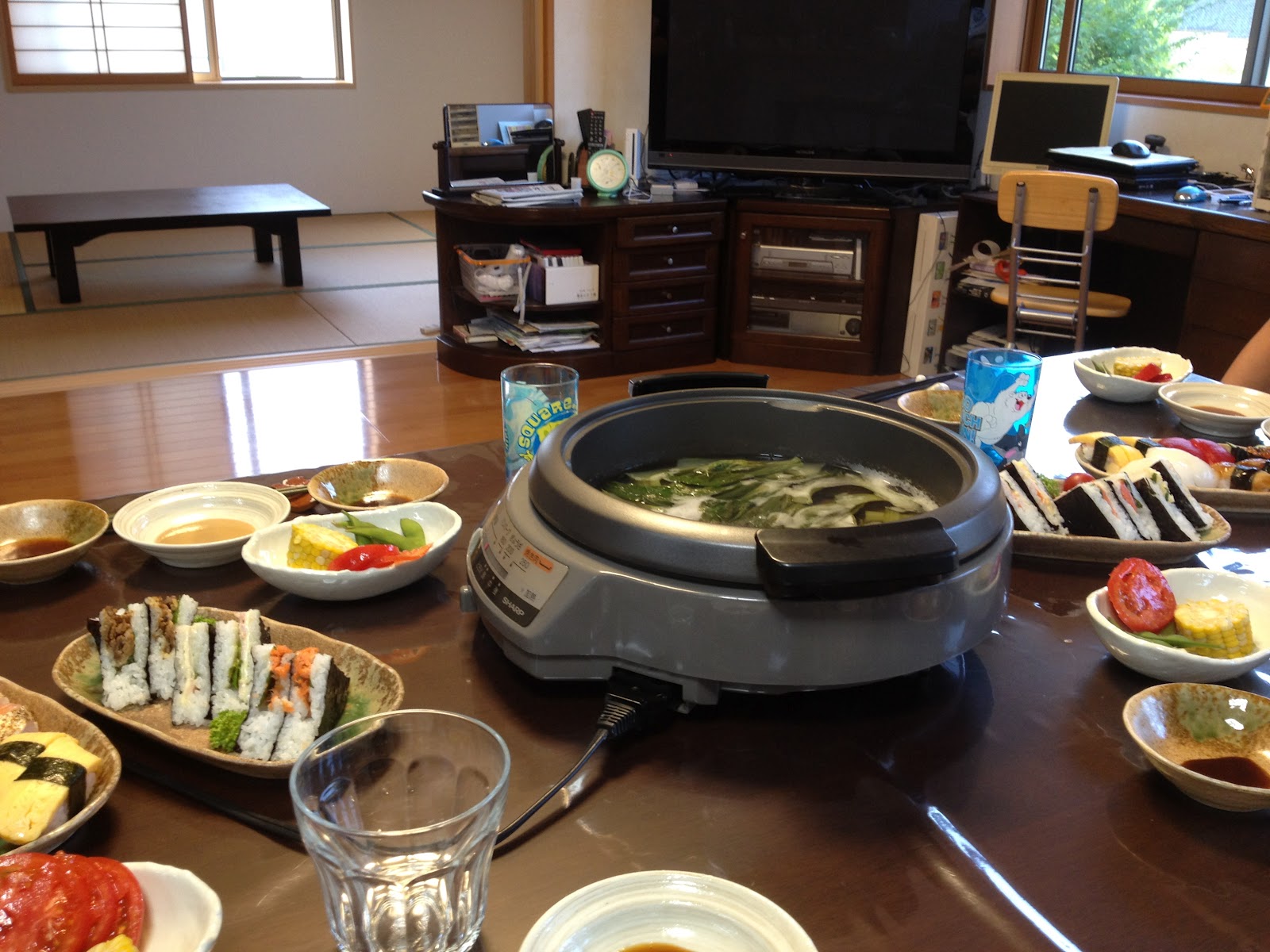
Delicious

            This last weekend, from Thursday to Sunday, I had the privilege to visit the capital of Ishikawa prefecture, the beautiful city of Kanazawa for the new Ishikawa JETs’ orientation. As Kanazawa was one of the few major Japanese cities to be spared the horrors of being firebombed during World War II, the city has preserved much of its traditional architectural heritage, making it very similar to Kyoto. Unfortunately, my trip did not begin on a high note as when I took the bus to Kanazawa, I missed the stop I was supposed to get off at and had to walk a good 30 minutes in the stifling heat (in a suit no less) to the prefectural office where orientation was being held. Despite this bump in the road, orientation was a lot of fun and it was great getting to meet all of colleagues in the Ishikawa prefecture. That night, several other JETs and I went to a cool restaurant in downtown Kanazawa where I had some very delicious raw tuna.

Kanazawa Station

            One thing that really caught my eye in Kanazawa the first night was the number of young people. The reason that this caught my attention can be traced to Japan’s demographic situation, and some would say, woes. Japan, especially in rural areas (aka my town) is currently suffering from a gross population imbalance where the old significantly outnumber the young. Indeed, rural areas in Japan suffer from this trend even more as virtually all of the young people flee to the cities after graduating from high school. I have certainly seen this demographic trend in Noto-Cho as everyone between the ages of 18 to about 30 is virtually absent.

            Anyway, I digress, the next day in Kanazawa was more orientation stuff followed by a bar crawl at the end of the day. The first bar we went to was owned by a fellow American and the people who went had great fun imitating each others accents (fun fact ask someone from New Zealand to say Moscow Mule with an American accent hilarious results will follow, kind of sounds like Yosemite Sam). Next we went to a St. Louis themed bar where the bartenders juggle booze for peoples birthdays and suffice to say it was a lot of fun watching them.
The average American according to New Zealand

On Saturday, I had the chance to do some sightseeing of the city and saw some really cool things. The first site I visited was Kanazawa Castle. The castle grounds were enormous and took me a good 40 minutes to explore in its entirety.

Kanazawa Castle

The only bad note at the castle was an absolutely terrifying encounter with the dreaded Osuzumebachi. Indeed, even the Japanese couples that were walking next to me absolutely started booking it when they saw this evil spawn of nature.

Watch out for the Suzumebachi

After this encounter with Satan-bee, I visited the nationally renowned Kenrokuen garden. I vow to return to this gorgeous place during Sakura season when the cherry blossoms are in full bloom. 

Scenes from Kenroku-en Garden

round noon, I headed over to a picnic by the Saigawa River that was being held by several older JETs and had a good time conversing with many old and new JETs.

Picnic at the river

            The next day, the Noto JETs and I headed back up to the depths of Noto and stopped by the city of Wajima on the way, which has a thriving market every Sunday. One of the highlights was going into an antique store that was actually selling Samurai armor, and medieval era katanas, spears and muskets. According to one of the older JETs, these old artifacts are evidently rather cheaper than one would expect in Japan as long as they weren’t owned by anyone famous. However, it is also quite illegal to take these artifacts out of the country so don’t expect any Samurai armor souvenirs. 

Samurai armor for sale!

I did, however make a fine purchase of grilled cuttlefish, which despite its rather intimidating looking appearance was quite tasty.

Grilled Cuttlefish

            That’s all for now folks, I expect something else amusing will happen this upcoming week. Randomly, I have been asked to read the English translation of “The Raven” by Edgar Allen Poe for the local international society. Having never done anything to do with poetry or dramatic reading ever this should prove quite interesting (half of me wants to say the lyrics to Barney the Dinosaur darkly and see if anyone can actually understand me). Also coming up this weekend is a local Matsuri (festival) in Wajima that is supposed to be a good time. 

Monday, August 6, 2012

Tokyo, Noto and The Two Japans

東京オリエンテーション(Tokyo Orientation)

Hello everyone! It’s been one week since my departure from America and a lot has happened since then. I guess I will begin with my departure from Chicago (which oddly enough seems like several months ago). After bidding farewell to my dad, with whom I drove to Chicago with, at the Holiday Inn Express near O’Hare, I began my life as JET. The Chicago orientation was pretty simple, just a few addresses by former JETs and Japanese officials on the importance of the program and the challenges we will face being a new culture, etc. After the orientation stuff was over, a few former Gusties (4 of us are in JET this year!) and I went to a nearby bar to have a few beers and watch the bizarre opening of the London Olympics and I daresay that the opening was very hilarious without any sound or context as to what was going on.

Anyway, the next day the real journey began when we got up bright and early to catch our plane to Tokyo! Then, after a grueling, leg-cramping, jet lag inducing 13-hour flight, we finally touched down in Narita airport, which is about 2 hours away by bus from Tokyo. The first thing I really noticed about Tokyo during the bus ride over is how truly massive a city it is both in scale and people-wise. At one point, the entire highway we were traveling on was surrounded by apartment buildings as far as the eye could see! After finally arriving at the Keio Plaza hotel in the Shinjuku district of Tokyo and having a satisfying bowl of udon noodles at a nearby restaurant, I promptly collapsed in my room around 9pm Tokyo time.


Enjoying the udon

Unfortunately, due to both being incredibly busy with orientation stuff and being incredibly jet lagged, I didn’t get to do a whole lot of exploring in Tokyo. However, I did get a chance one afternoon to take a stroll around Shinjuku and take in the megalopolis that is Tokyo. The city is certainly a bustling concrete jungle filled to the brim with crowds (certainly not a place for the claustrophobic). Indeed, reflecting back on it now living in rural Japan it really is striking how stark the difference is between Tokyo and my current living situation. Tokyo orientation itself consisted of many, many speeches by Japanese government officials, teachers, and current and former JETs. Most of the speeches were actually quite well done and interesting to hear (although it did get a tad bit repetitive towards the end). The rest of the orientation consisted of meeting with other new JETs placed in the Ishikawa prefecture (21 in all) and meeting new JETs going to Noto (6 in all).


Shinjuku
Japanese govt. official addressing the new JETs
It can get a bit crowded in Tokyo

Part 2 能登 (Noto)

The next day, (Wednesday August 1) I was off to a very different part of Japan compared to Tokyo, my new home of Noto! Having lived in Minnesota for pretty much my whole life, I inevitably must make comparisons between my two homes. In contrast to flat, lake-plentiful Minnesota, the landscape in Noto is very mountainous (which will make for some challenging drives come winter) and is surrounded by the ocean. One similarity between Noto and Minnesota is the stifling heat and humidity. Truly, it is almost like I never left Minnesota behind in regards to the weather as I have been perpetually sweating since I arrived. On the plus side, currently the ocean is ridiculously warm and really nice to swim in as I learned last weekend when a few JETs and I went to the beach, but more on that later.

There is, however, one more negative consequence to the abundant heat and humidity that surrounds me right now, which would be bugs, bugs, bugs. Walking outside, one is almost deafened by the huge quantity of cicadas chirping away all day. Spiders are on almost every house, as are a bunch of other random bugs I have never seen or heard of before. Thankfully, however, I have yet to run into two of the most notorious bugs in rural Japan…The first is the fearsome looking mukade, a giant, poisonous centipede that likes moist, dark places (apartments).
Fear incarnate

Although the mukade is poisonous, it thankfully won’t kill or incapacitate if it bites you, which leads me to the other notorious bug, the Osuzumebachi (in Japanese, giant sparrow bee, giant asian hornet in English). These suckers are particularly nasty, one sting from them is enough to hospitalize a full grown adult and it gets even better…Apparently when of them feels threatened or is attacking, it releases a pheromone, which calls all of its friends over to come join in the attack.
BEWARE!

Needless to say, if I come across one of these spawns of Satan, I will be booking it faster than a Japanese businessman running away from Godzilla.

Bugs of death and heat aside, I really do enjoy Noto a lot. The scenery is absolutely gorgeous! In comparison to Tokyo and Osaka there is green pretty much everywhere I look and all of the houses are built in a more traditional style. Furthermore, the seafood is sublime and really cheap. Plus, I have to rely on all Japanese as virtually no one here speaks English (which is what I wanted).
The village where my apartment is called Ukawa

Anyway, more about my personal experience as JET. To start off, here is a list of things that are exceedingly challenging and tiresome to do while jet lagged:

1.    Start a new job and meet your supervisor, boss, and co-workers all right in a row
2.    Meet the mayor of the new city you are moving to
3.    Have said meeting recorded for the local news
4.    Set up a bank account
5.    Set up internet
6.    Set up a phone plan
7.    Do all of the above in Japanese

Surprise! This is pretty much how my first day in Noto went down. The most interesting part was indeed visiting the mayor. First of all, I had no idea that I would be doing this until my supervisor casually mentioned it about 20 minutes before I would go and meet him. I was also casually told that the whole affair would be recorded for the local news, as a new JET coming to town is evidently a big deal. Thus, my nervous, exhausted self would have to do a brief self-introduction, in Japanese, and sit around and have a short chat. Another thing I was made aware of during my meeting with the mayor was how formal and serious an affair it was going to be. Indeed, there was a whole ritual for this sort of thing, which involved each person in the meeting having an assigned seat, an assigned number of bows to give and an assigned speech and formally giving me my work contract. Thus, I was a bundle of tired nerves when I gave my Japanese self-introduction and lets just say I have desire to ever, ever see that recording.
Meeting the mayor
Despite this road bump, the night definitely ended on a good note. After all of these exhausting procedures had been done, my supervisor treated my fellow Noto JET, Jillian, and me to a delicious okinomiyaki restaurant. Okinomiyaki is kind of like a Japanese pancake with eggs, meat, batter, veggies and whatever else you want in there, although usually topped with a sauce and mayonnaise.

The next few days have been mostly getting acclimated to my surroundings as school in Japan is out during August and therefore I really don’t have to much to do at the moment. Some of the cool sights I’ve seen in the Noto have been Mitsukejima (often called Battleship Island so named for its ship-like appearance). Another highlight was Senmaida, a bunch of scenic rice paddies by the ocean. Another great experience was going to my first beach in Japan. As I said before, the pool-temperature water was completely awesome to swim in. I was definitely a bit of a celebrity at the beach…one particularly vociferous group of Japanese thought it best to get my attention by both calling out “David” and by shouting out random English words.
Mitsukejima

Senmaida Rice Paddies

All in all, its been a very hectic first week filled with many challenges but also very many rewarding experiences and I continue to look forward to my time here.

Wednesday, July 25, 2012

準備 (preparations)

Very soon, my journey begins and I couldn't be more excited! Tomorrow I shall depart Minnesota for the first JET orientation in Chicago. As I pack and mentally prepare for a new chapter in my life, I inevitably think of my friends and family I am leaving behind.  I strongly believe that it takes a village to raise a child and thus, I certainly owe much to the very special and wonderful people in my life who have helped me grow, shared my joys, and shared my difficulties over the years. Special shout outs go to the Jeff Posse, my brothers in SAE, all my friends and advisors at Gustavus, and, of course, my family.

Today, I went to the bank to change virtually all of money into Yen, the Japanese currency. As I learned the last time I visited the country, Japan is largely a cash-based-society, making credit and debit cards largely ineffective. A downside for me, unfortunately, is that I must purchase a car when I arrive (I am in a rural area and therefore there is little to no forms of public transportation) and put down a deposit for my rent right away. I must therefore must carry large amounts of cash with me at all times. Thus, I will be constantly fretting over my vulnerable money supply as I make my way through the airport. On the plus side, I do feel exceptionally richer being able to hold this much money. 


Gonna make it rain!

After the Chicago orientation is over on Saturday the 28th, I will take off from O'Hare airport on a no-layover flight to Tokyo! Due to the tsunami, I never had the chance to go to Tokyo and I am very excited to see this behemoth of a city. In Tokyo, JETs from all over the world will meet at a hotel for a 3-day orientation that will be hosted by the Japanese government and CLAIR, which manages the JET program. After the 3-day orientation, the other JETs placed in the Noto area and I will fly to our new home. According to my predecessor, I will be teaching at a total of 6 different schools! Three of these will be elementary schools and three will be at middle schools. 

I know I promised a little bit more about Noto in my last post, but I figure that I will post more about it when I arrive and can give a first hand account and pictures!

Wednesday, July 18, 2012

みなさんようこそ! (welcome eveyone)

Konnichiwa and hello everyone! This is the blog I will be updating during my adventures in Noto, Japan through the JET Program (which I will be leaving for in 10 days!!!!). For those of you who don't know, the JET Program (an abbreviation for the Japan Exchange and Teaching Program) is a cultural exchange program led by the Japanese government that hires fluent English speakers to assist teaching English in public primary and secondary schools throughout Japan. The JET Program hires people throughout the English speaking world, but I have heard that the majority of those selected are American. I feel extremely honored to have this chance to participate in this program as it offers an invaluable opportunity to be a cultural goodwill ambassador for Americans and undoubtedly, I too will have the privilege to grow from the cultural experience.

As some of you may well know, my interest in Japan and the JET Program largely stems from my passion for history. During my time at Gustavus,  learning about the modern experience of Japan, especially the radical trajectory the nation took to become a modern nation-state, influenced my decision to peruse Japanese as a language and to eventually study abroad in Japan last year at Kansai Gaidai University (located in between Osaka and Kyoto). Unfortunately, my semester in Japan was cut short as the earthquake, tsunami, and radiation fears led to a mandatory evacuation mid-March. Despite the abrupt end to my studies in Japan, however, it reinforced my desire to learn Japanese and about Japanese culture. Thus, the JET Program offers a fantastic opportunity to continue my cultural journey.

Another reason I am so grateful to be in this program is that the process to get accepted has been a long and arduous procedure to say the least. The JET application (which consists of roughly 10 million forms) was released around late September and I turned in my written applications around mid-December. After about one month, I heard back from JET that I had made it to the interview stage of the process at the Japanese consulate in Chicago. After the most nerve-racking trip to Chicago of my life, I arrived at the consulate and did the best I could. Then, after two long agonizing months, I heard back that I had been accepted! After sending in about 10 million more forms in April, I again had to play the waiting game again for about two more months to hear where JET placed me in Japan. 

Last June, I received notice that I had been placed in Noto, a small village of about 20,000 people in the prefecture of Ishikawa. Here are some maps to give some perspective.

The highlighted part of the map is my prefecture of Ishikawa, located on the west coast of Japan facing China and Korea.


The highlighted area here is Noto (according to Wikipedia Noto is the result of several villages merging over time)


At first, I was a little apprehensive upon hearing I had been placed in such a rural and relatively isolated area. However, after doing a bit of research into Noto, I started to grow more and more fond of it. One of the highlights from the Wikipedia page was a section that talked about the Abare Festival, also known as the "fire and violence festival" in English. Evidently, the festival basically consists of hordes of drunken Japanese men carrying a shrine, lighting it on fire, and then proceeding to beat the ever-loving shit out of it in a river, which pretty much sounds like the most amazing thing I've ever heard. Also, I read how the area has some really spectacular scenery and great seafood (being so close to the ocean), two things which I really love. Furthermore, upon hearing wonderful things about Noto from current JETs, my predecessor, and my board of education, I can now say that I am irrevocably thrilled to be going here! (I'll talk more about Noto in the next post).

Anyway that does it for my first post. I am currently typing this from my cabin with internet connection speed so slow I might as well be in a black hole. Suffice to say, posting pics will take a while, and I want to post a few of Noto and Ishikawa. I will try, in between saying goodbye to all my dear friends and family, to post once more before I leave.