Tuesday, January 22, 2013

東京 (Tokyo)


On December 28th, I took the nightbus bound for Tokyo to meet up with my brother and my dad. Taking the night-bus (the cheapest option) would be a harbinger of many uncomfortable transportation experiences to come. The bus left at 11 at night and got to Tokyo around 6 in the morning. For reasons that escape me, the bus stopped for bathroom breaks and subsequently turned the lights on every hour. This made sleep near impossible on an already uncomfortable bus seat.

Anyway after arriving in Tokyo, I had a good 10 hours or so before Will and Dad’s plane arrived so I decided to acclimate myself to the Tokyo train/subway system and do some self-exploration. After a few hours, I was the master of the labyrinth that is Tokyo public transportation. One of the highlights was traveling by myself to Meiji Shrine near the Harajuku district and doing some sightseeing there. I finally met up with Will and Dad near Shinjuku station later that night and we concluded the evening by having some udon noodles at a nearby restaurant.

Meiji Shrine
The next day we went to the Tsukiji fish market and witnessed the thriving market atmosphere there.  Very interesting to see throngs of people gathering to get into very small sushi establishments next to the fish market. I guess sushi that fresh is worth the wait and the lines.
    
Will and I checking out the wares at Tsukiji

After Tsukiji, we went to the Hama Palace Garden, which was built as a retreat for the Shogun and his family, who also hunted duck here. Especially gorgeous was the Nakajima Teahouse where President Grant once sipped tea with the Meiji Emperor in the late 1800’s.

At the Hama Palace Garden

As we left the quiet atmosphere of the garden and the teahouse, we ventured to Tokyo Tower and got a glimpse of the very modern and futuristic buildings of Tokyo.  For lunch, we stopped at  a rotating Sushi restaurant that had the best I’ve ever had.

Tokyo Tower

Dad at the sushi restaurant
That night, I took Dad and Will to the Akihabara electronics district. Both of them were pretty overwhelmed by the district with its blaring lights sounds, and strange things popping such as maid cafes and anime pictures. Will summed up it up as much ”I’m tired and there’s all this weird shit coming at me.” To counter this assault on the senses, we decided it was an appropriate time to have a drink at the Park Hyatt Hotel (the one from Lost in Translation). The drinks were ridiculously expensive but the view from the bar was absolutely stunning. Well worth it for one drink I think.

Akihabara

View from the Park Hyatt
The following day we took a train to nearby Kamakura, which has a smaller town atmosphere and is riddled with temples. Some of the highlights include visiting a temple once owned by the powerful Hojo Samurai clan, a temple dedicated to divorcees, and visiting the Daibutsu, a colossal bronze statue of the Buddha. One amusing anecdote at the Buddha was when we went inside of it (as its hollow). The interior of the Buddha was packed with people and as we were trying to leave, we got caught behind a lady who would not assert herself through the crowd and leave. After about 5 minutes she finally seemed to get the idea that there was nothing to do but shove her way through the crowd and exit before the whole statue got clogged. As I will talk about in a few posts, this reaction of being too polite to shove will contrast wildly with my experience in China.

Shrine at Kamakura

The Daibutsu

On the third day, we ventured to Northern Tokyo and our first sop was Ueno Park, which has an ambience similar to New York’s Central Park, a nature-filled atmosphere with museums galore. Unfortunately, almost all of the museums were closed due to the encroaching New Year holiday.

We then wandered in Northern Tokyo for a bit until we accidentally stumbled on to Ameyokocho, Tokyo’s thriving market, which reminds of the Grand Bazaar in Istanbul. This place was so unbelievably crowded! It took forever to navigate though the crowd. After surviving one congested street, we went to yet another at Senso-ji. This cool temple began with enormous gate at its front adorned with the kami of thunder and wind. Beyond the gate was an extensive road filled with small shops. At the end of this narrow market place was an enormous temple with a beautiful and lavish interior.
Crowded market at Ameyokocho

Strolling around Ueno

The gate to Senso-ji

The long market road at Senso-ji
As it was raining that night, we were walking though one of Tokyo’s underground tunnels when I saw on the most heartwarming things I’ve ever seen. Towards, the end of the tunnel, we began to hear some music being played, which I recognized as being from Hayao Miyazaki’s famous movie, Totoro. When we got closer, we noticed that it was coming from one guy dressed up in a black suit playing on his trumpet. We also noticed that he was playing it for the homeless (who were camping in the tunnel). I don’t who he was or why he was doing it but it was still a really uplifting scene to witness.
Playing for the homeless


Sunday, January 20, 2013

Long expected update and Christmas in Japan.


Well folks its been a while and many many adventures to tell so let’s dive right in. I’ll start with my first Christmas in Japan.

Christmas in Japan is basically an amalgamation of all the things I hate about Christmas with none of the aspects about it that I like. For starters, it must be made perfectly clear that I despise Christmas music in all of its forms. This Grinchish behavior can largely be attributed to my stint as a grocery bagger where inevitably after every Thanksgiving I was subjected to Christmas music playing on a loop non-stop for about a month and a half and let’s just say one can only listen to so many renditions of “Silver Bells” before they go mad (to this day I still can’t listen to this song without developing a nervous tic and feeling a strong urge to annihilate whatever or whoever is playing it.) Thus, much to my utter dismay, Japan too follows the maddening ritual of playing Christmas music starting around late November. Indeed, by the time Christmas rolled around I dreaded going grocery shopping as I knew I would be tortured with another five versions of “Jingle Bells,” “Silver Bells” and whatever other shitty song about bells and winter that have been spawned by people trying to erode my last remaining bits of sanity. 


The part about Christmas that I do like, however, is spending time with friends and family in a relatively stress-free environment. This aspect of Christmas was unfortunately absent and it was definitely a time when homesickness hit me the hardest. In fact, for all the hulabaloo and ads Japan puts on about Christmas, the actual delivery is underwhelming. Evidently, the big tradition is to buy some fried chicken and “Christmas cake” and eat them…and that's pretty much it (I even had to go to work on Christmas day.)

Fortunately, I had a pretty good Christmas eve though. I started off the day by going to a local glass museum with Jillian and one of the office ladies at my school named Miwani-san. We saw some pretty neat glasswork and afterwards, Miwani-san treated Jillian and me to a nice western-style lunch with pasta and superb desserts. Afterwards, the three of us went to Jillian’s place to whip up some home-made pancakes and damn they were good! Although fruit is super expensive in Japan it sure does taste good and made the pancakes taste awesome. For dinner, Jillian and I joined two other JETs in the area, Zac and Amber for some Chinese food (reminds of A Christmas Story) and had some greasy delight.
Delicious Christmas dessert
Christmas Pancakes

Enjoying them.
While Christmas day was pretty lonely, I was nevertheless in pretty good spirits afterwards, as I would be bound for Tokyo in a few days to meet up with my dad and my brother.

Before I jumped into my Tokyo exploits, I did experience one more intersting part of the Japanese office life…the enkai’s estranged brother the Bonenkai, which is yet another excuse for coworkers and the bosses to get absurdly drunk together. The reasoning behind the Bonenkai is that it is a way to forget the bad parts about the previous year and to welcome in the hopefully better new year…and what better way to do that than by having an ancient Rome style hedonistic feast of food and drink.

Monday, December 10, 2012

Winter Has Come

As my life is now controlled by the wild cluster@*%# that is Ishikawa weather, its time to divulge the latest madness. Winter has come to my region with a fury. I have seen weather conditions in the past three days that I never even thought existed. (And when a Minnesotan is shocked and appalled by the weather you know something is wildly wrong with this picture). The first startling aspect of the winter in Ishikawa is that snow here does not fall like normal snow should. Instead, it behaves rather like its summer-time cousin, hail, and pelts you with big pachinko-shaped balls of ice and slush (the slush ones kind of explode on impact). The second bizarre surprise Ishikawa winter throws at you is lightning snow. No that wasn't a typo, I'm dead serious, lightning, freakin, snow. Evidently, apocalyptic atmospheric conditions (something sciency about the Siberian winds crossing with the flow of the Sea of Japan) dictate that the seemingly incompatible phenomenons of lightning and snow can happen at the same time over here.

Thus far, the quantity of the snow has been ridiculous, which given the rainpocalypse in November, I was at least able to see coming. In the span of only one night, my world went from no snow at all to this:


The snow begins
One day later
This was a a pain in the butt to scope off. The snow here is very thick and slushy.
Ok it is all a bit pretty though
Compounding the limitless lightning snow is my sworn enemy, cold. Although Minnesota winters are definitely colder in terms of temperature, one can at least escape the booger freezing weather by seeking shelter indoors. This is not the case in Japan. A rather amusing article posted on cracked.com recently mused on how despite Japan`s popular perception as a technological wonderland, the heating systems here are rather abysmal. The article really hit the nail on the head especially at many of my schools. As evidence, may I present the pinnacle of heating technology, the lastest device in the war against cold, a tea kettle on gas stove.

Tadah!

To be fair, its not like people here just like being colder than Americans. One of the reason I really enjoy studying geography is that it plays such an an enormous role on the lives we live. Indeed, I believe that my being colder here than in that it has more to do with geography of Japan rather than the people. With the exception of shale, Japan has very few domestic energy resources and according to the United States Energy Information Administration, is only 16 percent energy self-sufficient (compare this to America which is around 70%). This lack of domestic energy sources, compounded with Japan being the third largest oil consumer in the world has made the pricey importation of foreign oil very important to Japan’s modern economy. The March 11 Tohoku Earthquake, Tsunami, and subsequent meltdown at Fukushima has exacerbated this energy dilemma. After the Fukushima disaster, many Japanese are demanding that all nuclear power be abolished (which due to Japan's geographic location on the Pacific fault line and chronic earthquakes and natural disasters that follow raise a rather fair point). The problem, however, is that it has been estimated that this reduction in nuclear power will mean that Japan ‘s oil and gas consumption will and have skyrocketed along with the cost of energy. As I am aware that schools don't have magical budgets that can create money out of nowhere, I guess that means I will have to just put up with more or less always being cold for the time being. 

Anyway, wintertime is also Christmas time and it has been a rather interesting observing the Christmas season here. As Japan is mostly a non-christian nation, most people here are only aware of Christmas on the most superficial of levels. In fact, from what I've heard thus far, most people here are hardly even aware that there is a religious component behind it. (Some Christmas traditions here include buying a christmas themed cake and going out to buy KFC.) Thus, schools here have no compunctions about asking me to teach Christmas lessons. One of the most amusing things to observe in my Christmas lessons is the portion where I demonstrate how to make a paper snowflake and then let the kids make their own. Whether they are 1st or 9th graders, all of the students really really really like this activity and take it really really really seriously. Whereas I recall being content to cut a triangle or three in mine and call it a day, there are many students every class who spend around 20 minutes constructing the best damn snowflake they can make. I've even had one guy who spent the whole class secretly working on his snowflake so that it would pop-out 3-D. 

Unfortunately, one of my Japanese teachers insisted that I play Christmas music during one of my lessons. Call me the grinch, but I can't stand the stuff ever since I worked at a grocery store that played the stuff on loop for weeks on end. I'm sorry, but once I heard "Silver Bells" for the twelfth time in one day, I forsake Christmas music forever and being relatively isolated from it has been a great great blessing. That being said, I can't pretend that I miss other parts of Christmas, mostly being with friends and family (and eating delicious cookies). At least I'll be getting my fix when my dad and my brother come to visit me in a few weeks! We will be hanging out in eastern Japan for about a week or so and I am very very excited to see them and to tour Tokyo. Any who, that's all for now folks I'm not sure I'll be having too many exciting adventures until winter break unfortunately as I am trying to save money for the epic trip but I'll post if anything exciting comes up.


Saturday, November 24, 2012

Rainpocolypse and Thanksgiving


Whew! After a long absence I'm back! I'll just jump right in to what I've been up these past weeks. Being very much afflicted by the weather these past few weeks, I'll start there. Japan is well known for having a rainy season that pops up roughly around June every year. The exception to this rule seems to be my region which has been perpetually bombarded by rain for the last 2-3 weeks almost nonstop. I've never seen rain go on for this long and it we even had thunder and lightning for about 3-4 days in a row! As much as I love rain and storms, I can't pretend that this is a little much and I am desperately hankering for some solar power soon. 

On the plus side, since all the crappy weather has also made it impossible to do my regular runs and bike rides, I have been forced to get acquainted with Sean T. and have been slowly getting my butt kicked by insanity less and less.

Despite the relentless torrent of rain, the nature and fall scenery in Ishikawa continues to be sublime. Two weekends ago, I got a chance to head down to Kanazawa to do what they call in Japan "Autumn Leaf Hunting." As I coming to realize, Japan really values seasonal activities and foods.  In a conversation with one of my Japanese English teacher, I was told that there are certain times when one should go to certain places and certain foods that should only be eaten during a specific season.

Kenrokuen Garden at Autumn

Kanazawa Road

Train I took to get Kanazawa oh Japan:)
After I finished my fall leaf hunting excursion, some fellow JETs and I went out to eat in Kanazawa and had Japan's version of "Chinese" food. Japanese Chinese food differs significantly from American Chinese food in that they are a lot less meat focused and usually feature ramen, potstickers, and tofu related dishes. It's really interesting how Chinese menus seem to change and adapt to the respective cultures' tastes that they are surrounded by. (Although they all remain pretty greasy and delicious).
Japanese/Chinese Meal

Fried Gyoza

Spicy Tofu Dish

To combat homesickness and to bring a little bit of home to Japan, several JETs and I had a Thanksgiving feast yesterday where we all contributed our own side dishes. I brought a little Norwegian/Minnesota pride by making some lefse by scratch. Although they turned out pretty well in the end, I daresay I shan't be making them again in the near future. The reason is that these suckers evidently need about a metric ton of flour in order to make them less adhesive to one's rolling pin. Flour is also pretty darn expensive in Japan so I ended up having to throw down more than 10 dollars on flour just to make one batch.

Ya sure you betcha it's some lefse doncha know!
 Other goodies that JETs made included some usual staples;  potatoes, cranberry sauce, pumpkin pie, etc. However, we did get some entries that were new to my thanksgiving experience. Some Japanese friends of one of the JETs brought over a bowl of chopped cow tongue, another person made some vietnamese spring rolls. My favorite entry, however, was made by a guy named Jiri, a guy from the Czech Republic who brews beer in a local restaurant made some fabulous Czech beer! As most of the beer in Japan tastes like keystone in my opinion, having a good brew made for a most jovial Thanksgiving indeed.

Jiri

Of course, no Thanksgiving celebration is complete without Turkey and thankfully, one of the JETs was able to deliver! As there are virtually no turkeys in Japan, I'm quite happy they were able to acquire this delectable specimen. 
Turkey!

Overall a very fun night.
All in all, a very fun night that helped fight some of the homesickness. (Still can't make up for the many wonderful friends and family back in the states though).

In other exciting news, I have booked a flight to see my friend of colossal proportions, Colleen O'Connor, in China at the beginning of January! I will be visting her in the city of Kunming, which is in the Yunnan Province in Southern China near the borders of Tibet and Vietnam. It will be weird going to China and not seeing Beijing, the Great Wall or any other famous spots, but I nevertheless expect the adventure of a lifetime.

I am also very glad I was able to book the trip because the process of it was an enormous ordeal! For starters, I had to send money back home in order to put money on my American credit card so I could purchase a ticket (Japan really isn't big on credit cards and almost all financial transactions are done in cash). The process of sending money home was about as pleasant as a rectal exam. For starters, After completing the very very detailed form to send money home, I was told by the post office worker that I had to do the whole thing over because I hadn't put my address in Japanese characters. After meticulously rewriting the whole, much to my horror, I discovered that I had accidentally switched the numbers of my American and Japanese bank accounts and had to start over yet again. So, after two hours of hell, I finally was able to turn in my form.

The next major challenge to my upcoming trip has come in the form of obtaining a Chinese tourist visa. As the Chinese embassy infuriatingly won't accept applications by mail and the closest one to me is 8 hours away in Tokyo, I had to dig in the recesses of the internet to find a Japanese company that could apply for the visa by proxy. After searching the internet high and low, I came across a very badly translated site that says it can do such a thing. As I found the link on A JET forum I really really hope this company will prove able to process my application...I also had to give them my passport as well so I am praying to whatever the patron god of bureaucracy is here that my application and visa will find there way through the system at the moment.   

Anyway, here's hoping it will all work out in the end.

Tuesday, November 6, 2012

The Way of the Sword and Ancient Ruins

Since I began living in Japan, I have been itching to try my hand at some form of martial art. After mentioning this at my Board of Education, I am now officially taking kendo lessons at a nearby dojo every Wednesday and Saturday evening! 

For those that are unfamiliar, kendo, which roughly translates as "the way of the sword," is a Japanese martial art that concerns itself with swordsmanship (albiet with bamboo replicas called shinai and not the real deal) and cultivating a focused mind.

The shinai

Kendo is similar to western fencing in that competitions are about gaining points by being the first to strike against ones opponent in certain areas of the body. In kendo, there are four basic pieces of equipment that one wears and is allowed to strike. The first is the men that covers the face and shoulders. 

The men

The next is the do (pronounced like Homer Simpson's iconic d'oh) that covers the chest. 

The do

Next is the tare ( pronounced like a Canadian saying "tar" then "eh") that covers the waist. 

The tare

The last pieces are the kote (pronounced like a Candian saying "coat" then "eh") which cover the hands.    


The kote


Yet, kendo slightly differs from western fencing in that it not only encourages physical self-cultivation, but mental discipline as well. This concern with ones mental state can largely be attributed to kendo's history. Kendo's origin's can be traced to two key points in Japanese history, the development of Buddism and the origins of the Samurai warrior class. Back in the day (around 1000-1600 A.D.) Japan had yet to become a unified country and thus suffered from chronic civil war. This period of warfare and instability lead to the proliferation of an increasingly influential militaristic aristocratic class. These warriors would later developed in to the renowned Samurai we all love today. Developing at roughly the same time as the Samurai class were new sects of Buddhism in Japan. One of the most influential Buddhist teachings to emerge during this period was Zen (heavily influenced by Buddhism in China), which emphasized awareness with ones surroundings and the ephemeral nature of life. Since warfare and battle were constants in the nasty, brutish and often short life of the Samurai, it was only natural that Zen had a lot of appeal. Thus, swordplay in the Samurai way of life emphasized not only physical training, but training ones mental state of being as well. Although the Samurai are long gone, many of the ideals of the warrior code survive in modern kendo. Indeed, the point of kendo, as I am often told by my sensei, is more concerned with calming and preparing ones mind and spirit rather than on winning a match. 

Having never done kendo in my life, I am currently practicing with elementary-age kids (many are my students) and so far, practices have consisted of the following:

We start by doing a series of taiso or exercises and warm ups.

Next, all the students line up and sit in the proper seika poistion (where one sits on their feet, which I daresay is quite painful on the hardwood floor we practice on at the moment) followed by chanting the names of the various pieces of armor, the men, the do, tare, and the kote (why this is I have yet to figure out). After that, we place our hands on the floor and do a low bow towards the sensei to show respect and humility.

Since I am a novice I usually get a private lesson from the second in command while the sensei leads the rest of the class. Thus far, I have learned how to hold the shinai properly, how to step properly, how to yell properly, how to bow properly, and how to sit properly as it seems there is a right way to do virtually everything in kendo (part of the mental discipline I assume). So far, everything I have done has been greeted with a coy smile from my instructor followed by a it`s difficult isn`t it so I can only assume I am blundering my way through at the moment. Nothing to do but practice, practice, practice I guess. Also, as the whole class is conducted in Japanese, I will naturally be a bit of slow learner, seeing as I can only understand about 50% of what my instructor says at any given moment.

We then end the class the same way as we began, by doing exercises and bowing again to the sensei. Anyway, here's hoping my warrior spirit will increase in the coming days.

As I had a whole day to myself and the weather was gorgeous (around 65 degrees!) last Sunday, I decided to do some self-exploration around my town. My first stop was the Makaki Ruins, which are about a 20 minute drive from my house. This site boasts one of the few archaelogical ruins of the Jomon culture, which thrived in Japan around 6,000 years ago.  Although the museum itself turned out to be closed for the day, I nevertheless got to see the excavation site and a few reconstructions of some the remains found around the surrounding area.


Beautiful autumn day at the Makaki Ruins

Reconstruction of a Jomon era Monument at Makaki Ruins


The wood circle

Excavation Site

After my excursion at the ruins, I stopped by the grocery store for lunch and to my pleasant surprise, someone was carving up a fresh tuna right at the entrance. Since there was a huge crowd of locals clamoring to get some tuna, I decided to do as the romans do and buy some myself (it was quite delicous).
Giant tuna at the grocery store (there was a stampede of people behind me)
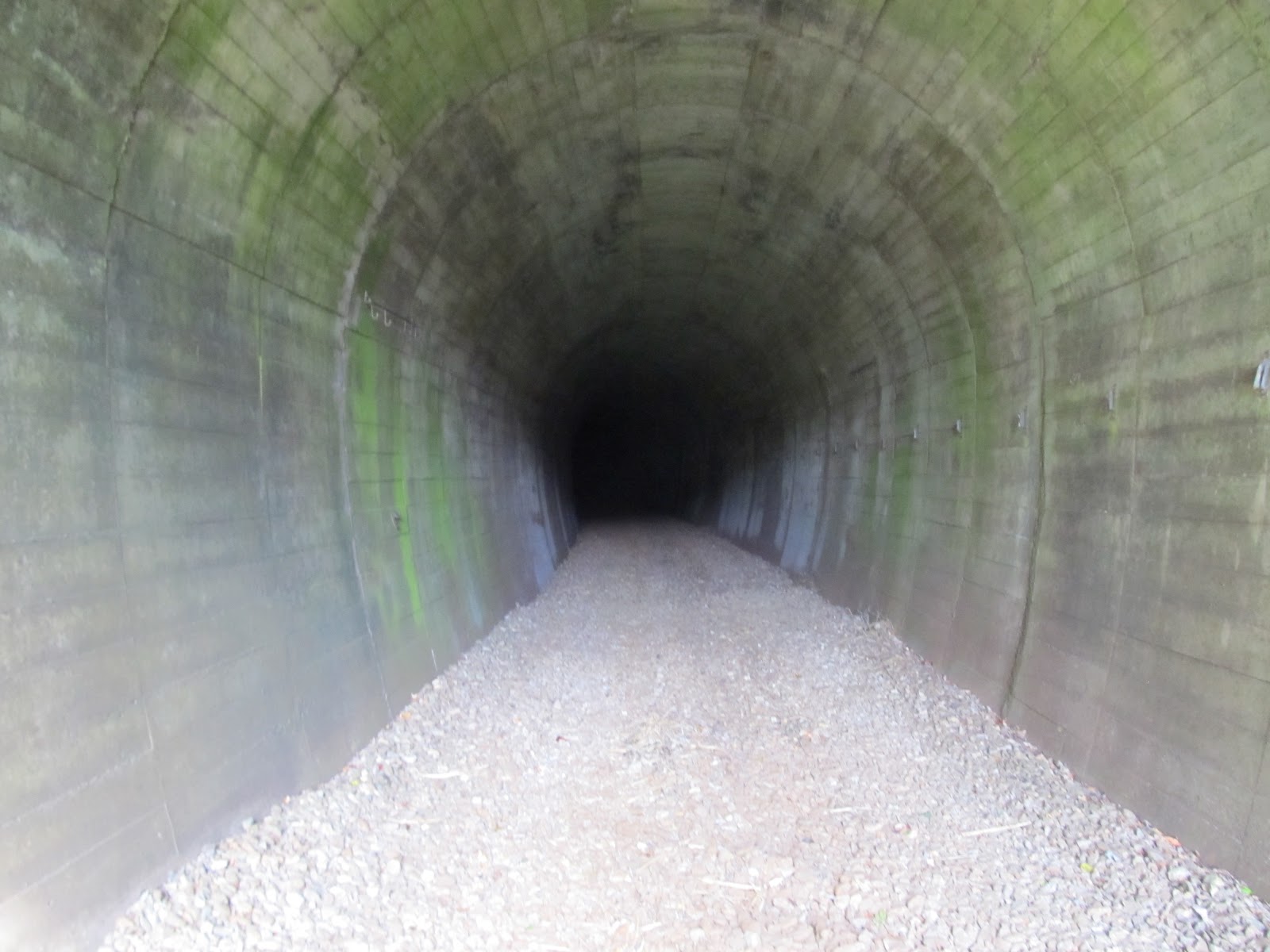
After returning home and storing my precious tuna, I decided to take a little hike around my village. My first excursion was the area behind my apartment, which until 2005 was a railroad. Evidently, the railway became defunct as the population in my town became too low to merit continued service.

Old railroad by my apartment

Tunnel of doom! Kind of reminded of Miyazaki`s Spirited Away
My next path lead me along the ocean and some of the country roads Noto has to offer.

Mountains across the sea

Country road by the ocean

All in all a beautiful day
On a final note, I will definitely be keeping my eye on the election tomorrow. Thus far, none of my coworkers have even acknowledged that there is an election happening in 'murica so I might be the only one looking/caring at the office.